
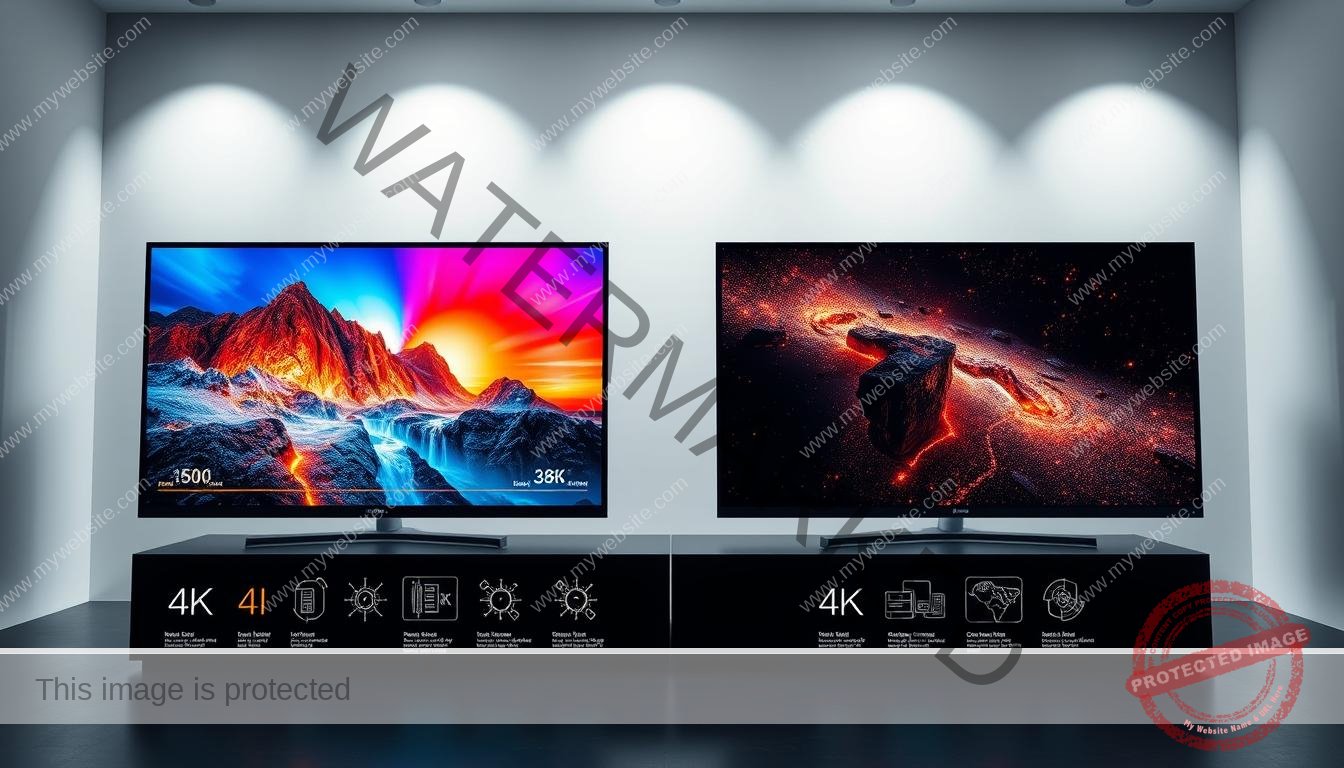
The world of television technology is rapidly evolving, with resolution being a key factor in the viewing experience.
We are witnessing a significant technological advance in modern TV displays, with the resolution battle between 4K and 8K being at the forefront.
The difference in pixel count between these technologies impacts overall picture quality, but the question remains whether the human eye can perceive these differences.
We will explore the key differences between these technologies to help you understand which might be better for your viewing needs.
Key Takeaways
- Understanding the practical implications of choosing between 4K and 8K technologies.
- Analyzing whether the price premium for 8K technology is justified.
- Examining the impact of pixel count on picture quality.
- Comparing technical specifications and real-world performance.
- Evaluating value considerations for your purchase decision.
Understanding Resolution: The Basics of 4K and 8K
As TV technology advances, understanding the basics of 4K and 8K resolutions becomes increasingly important for consumers. The resolution of a TV is a critical factor in determining the quality of the viewing experience.
What Defines 4K Resolution
4K resolution is defined by approximately 8.3 million pixels (3840 × 2160), creating what was previously considered the pinnacle of home viewing clarity. This resolution provides a significantly sharper and clearer image compared to its predecessors.
What Defines 8K Resolution
8K resolution represents a massive increase to approximately 33.2 million pixels (7680 × 4320), quadrupling the total number of pixels compared to 4K displays. This results in an even more detailed and immersive viewing experience.
The Pixel Count Difference
The difference in pixel count between 4K and 8K is substantial. To illustrate this, consider the following table:
| Resolution | Pixel Count | Pixels Per Inch (PPI) |
|---|---|---|
| 4K | 8.3 million | Lower density |
| 8K | 33.2 million | Approximately 160 |
The increased number of pixels in 8K displays theoretically creates smoother curves, sharper edges, and more detailed images at any screen size. Understanding pixel density is crucial for comparing these technologies.
Strong 4K vs My 8K: Key Technical Differences
Understanding the technical nuances between Strong 4K and My 8K is crucial for making an informed decision. As we delve into the specifics, it becomes clear that the differences between these technologies are multifaceted, impacting various aspects of the viewing experience.
Resolution Comparison
The most obvious difference lies in the resolution. My 8K boasts a significantly higher resolution than Strong 4K, with 33.2 million pixels compared to 8.3 million pixels. This translates to a much higher pixel density for 8K, potentially leading to a sharper image when viewed up close or on larger screens.
| Technology | Resolution | Pixel Count |
|---|---|---|
| Strong 4K | 3840 x 2160 | 8.3 million |
| My 8K | 7680 x 4320 | 33.2 million |
Pixel Density and Image Clarity
The difference in pixel density between Strong 4K and My 8K becomes most apparent on larger screens. At closer viewing distances, the higher pixel density of My 8K can provide a more detailed and clearer image, reducing the visibility of individual pixels that might be noticeable with Strong 4K.
Color Depth and HDR Capabilities
Both Strong 4K and My 8K support HDR (High Dynamic Range), which enhances picture quality by offering better contrast and a wider range of colors. However, My 8K may have an edge in terms of color depth and HDR capabilities, potentially providing a more immersive viewing experience with more vivid colors and nuanced contrast.
As we compare these technologies, it’s clear that My 8K offers several technical advantages over Strong 4K, particularly in terms of resolution and pixel density. However, the actual impact on the viewing experience depends on various factors, including screen size and viewing distance.
The Viewing Experience: Can You See the Difference?
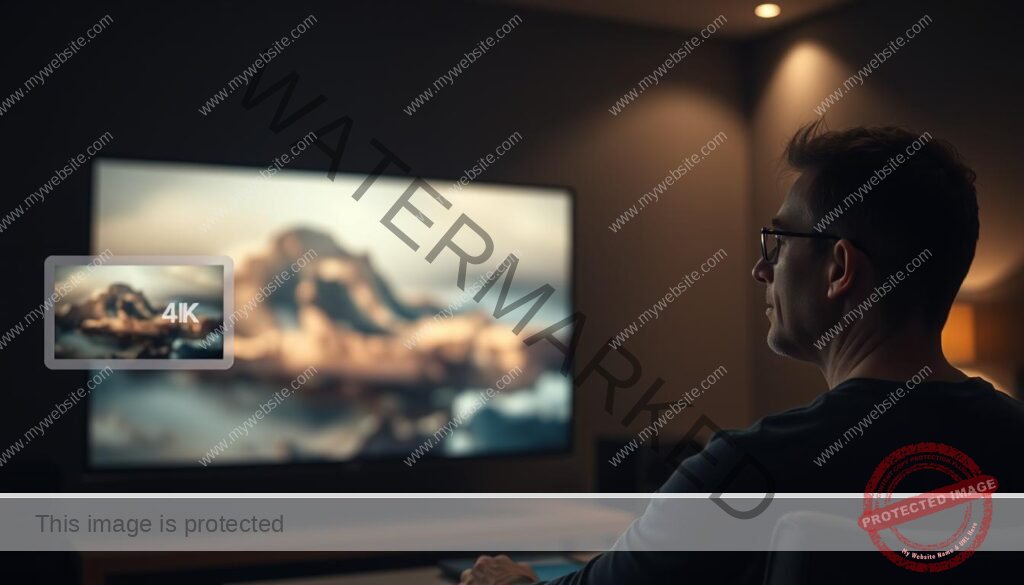
Understanding the limitations of the human eye is key to determining whether 8K offers a significantly better viewing experience than 4K. The human visual system has its own set of constraints that dictate how we perceive resolution.
Human Eye Limitations
The human eye has a finite capacity to resolve detail, often quantified in terms of cycles per degree. For someone with 20/20 vision, this is generally accepted to be around 30 cycles per degree, though individuals with sharper vision, like 20/12.5, can resolve up to 48 cycles per degree. This limitation creates a natural ceiling for the benefits of higher resolutions at typical viewing distances.
To put this into perspective, let’s consider a viewer with a 65-inch TV, sitting 6.5 feet away, and having 20/12.5 vision. The screen width is approximately 56.65 inches, subtending an angle of about 40 degrees at the given distance. With 20/12.5 vision corresponding to 48 cycles per degree (or 96 pixels per degree), the viewer can distinguish 96 * 40 = 3840 pixels horizontally, which aligns with UHD 4K resolution.
Optimal Viewing Distance
The distance between the viewer and the screen plays a critical role in determining the perceived resolution. Sitting too far away can make it impossible to appreciate the difference between 4K and 8K, as the angular resolution (the angle subtended by the pixels at the viewer’s eye) decreases with distance.
For instance, at a viewing distance of 6.5 feet from a 65-inch screen, the difference between 4K and 8K may not be discernible even for someone with excellent vision. It’s only when the viewing distance is reduced, or the screen size is significantly increased, that the benefits of 8K become more apparent.
Screen Size Considerations
Screen size is another crucial factor that influences the perceived difference between 4K and 8K. Larger screens can take full advantage of higher resolutions, making the upgrade to 8K more worthwhile.
| Screen Size | Viewing Distance for 4K | Viewing Distance for 8K |
|---|---|---|
| 40 inches | 4-5 feet | 2-3 feet |
| 65 inches | 6-8 feet | 3-4 feet |
| 85 inches | 8-10 feet | 4-6 feet |
This table illustrates how screen size and viewing distance interplay to affect the perceptibility of 4K and 8K resolutions. For larger screens, viewers can sit farther away and still appreciate the higher resolution.
In conclusion, the viewing experience is influenced by a combination of the human eye’s limitations, viewing distance, and screen size. While 8K offers a higher resolution, the benefits may not be noticeable under typical viewing conditions.
Content Availability: What Can You Actually Watch?
As we weigh the benefits of 4K versus 8K, it’s essential to examine the current state of content availability. The type of content you can watch on these resolutions significantly impacts the viewing experience.
Native 4K Content Landscape
The landscape of native 4K content has grown substantially across various platforms. Streaming services, physical media, and broadcast television have all seen a significant increase in 4K content offerings. Many popular streaming services now offer a wide range of movies and TV shows in 4K, making it easier for consumers to access high-quality content.
Current State of 8K Content
In contrast, the availability of native 8K content remains extremely limited. Very few movies, television shows, or streaming options offer true 8K video. However, 8K AI Upscaling Technology is bridging this gap by enhancing 4K content to 8K resolution, providing a superior viewing experience.
Upscaling Technology and Its Effectiveness
Upscaling technology plays a crucial role in enhancing lower-resolution content to take advantage of higher resolutions like 8K. The effectiveness of AI-powered upscaling technology in enhancing 4K content to 8K is noteworthy. It significantly improves the viewing experience by providing a more detailed and clearer image.
| Resolution | Native Content Availability | Upscaling Effectiveness |
|---|---|---|
| 4K | High | N/A |
| 8K | Low | High |
HDMI Standards and Connectivity Requirements
To fully leverage the capabilities of 4K and 8K resolutions, it’s essential to comprehend the underlying HDMI standards and connectivity requirements. The HDMI standard has evolved significantly to support higher resolutions and refresh rates, making it a critical component in the overall viewing experience.
HDMI 2.0 vs HDMI 2.1 Specifications
HDMI 2.0, launched in 2013, supports 4K resolutions at 60Hz with an 18Gbps bandwidth. In contrast, HDMI 2.1, introduced in 2017, offers a substantial upgrade with a 48Gbps bandwidth, enabling support for 8K resolutions at 60Hz and even 10K at 120Hz. This significant leap in bandwidth is crucial for the higher data transfer requirements of 8K content.
| Specification | HDMI 2.0 | HDMI 2.1 |
|---|---|---|
| Bandwidth | 18Gbps | 48Gbps |
| Maximum Resolution | 4K at 60Hz | 8K at 60Hz, 10K at 120Hz |
| Refresh Rate Support | Up to 60Hz | Up to 120Hz for 8K |
Bandwidth Requirements for 4K and 8K
The bandwidth requirements for 4K and 8K content differ significantly. 4K content at 60Hz requires approximately 18Gbps, which is adequately supported by HDMI 2.0. However, 8K content at 60Hz demands up to 48Gbps, necessitating the use of HDMI 2.1 for optimal performance. This increased bandwidth ensures that the higher pixel density of 8K resolution is properly supported.
Cable Types and Compatibility Issues
The type of HDMI cable used can also impact performance. Ultra High Speed HDMI cables are required for 8K transmission due to their ability to handle higher data throughput. Compatibility issues may arise when connecting older source devices to newer 8K displays, potentially resulting in signal degradation or feature limitations. Ensuring that both the source device and the display support HDMI 2.1 is crucial for an optimal viewing experience.
Understanding these connectivity requirements is vital for consumers looking to upgrade to 8K technology. By choosing the right HDMI standard and cables, viewers can ensure they are getting the best possible performance from their devices.
Price Comparison and Value Proposition
As consumers weigh their options between 4K and 8K TVs, the price difference becomes a crucial point of comparison. The market currently presents a significant disparity in pricing between these two technologies, influencing consumer decisions and perceived value.
Current Market Prices for 4K TVs
The prices for 4K TVs have become increasingly competitive, with premium models available in the range of $800 to $1,000. High-end models, often featuring advanced technologies like OLED panels or higher refresh rates, can cost between $2,000 and $3,000. This range offers consumers a variety of choices based on their budget and desired features.
Investment Required for 8K Technology
In contrast, 8K TVs represent a significantly higher investment. Entry-level models typically start at $3,000 to $4,000, while premium models can exceed $5,000 to $10,000, depending on the size and features. This substantial price premium raises questions about the value proposition for consumers.
Long-term Value Assessment
To assess the long-term value, we must consider how quickly 8K TV prices are likely to decrease over time, similar to the trend observed with 4K TVs. Additionally, the total cost of ownership should include potential additional expenses for compatible accessories and content subscriptions. Consumers should weigh their immediate needs against future-proofing their home entertainment systems.
- The current market pricing shows a significant gap between 4K and 8K TVs, with 8K being substantially more expensive.
- The investment in 8K technology may be justified for those seeking future-proofing and willing to pay a premium for the latest technology.
- Consumers should consider the price and the potential for future quality improvements in their purchasing decision.
Ultimately, the decision between 4K and 8K TVs depends on individual priorities and budget constraints. As we move forward, the way consumers approach this decision will be influenced by the evolving market and technological advancements.
Gaming and Media Consumption: Performance Analysis
In the context of gaming and media, understanding the performance capabilities of 4K versus 8K is crucial. As we analyze the performance of Strong 4K and My 8K displays in gaming and media consumption, several key factors come into play.
Frame Rates and Refresh Rates
The frame rate and refresh rate capabilities of a display significantly impact the gaming experience. With HDMI 2.1, 8K displays can transmit data at 60 frames per second (fps), while 4K content can reach up to 120fps. In contrast, HDMI 2.0 is limited to 4K at 60fps. Higher refresh rates are crucial for reducing motion blur and providing smoother gameplay.
Input Lag and Response Time
Input lag and response time are critical for competitive gaming. We examine the differences between comparable 4K and 8K displays, noting that lower input lag and faster response times are essential for fast-paced games. The technology behind 8K displays is continually improving, but 4K displays currently offer superior performance in this regard.
Gaming Console and PC Compatibility
The current generation of gaming consoles, such as the PS5 and Xbox Series X, can output 4K at 120fps but lack native 8K support at high frame rates. For PC gaming, only the highest-end graphics cards can drive 8K displays at acceptable frame rates for modern games. This limitation affects the immediate benefits of choosing an 8K display for gaming.
| Display Type | Max Frame Rate (HDMI 2.1) | Gaming Console Support | PC Gaming Compatibility |
|---|---|---|---|
| 4K | 120fps | Native support up to 120fps | High-end GPUs required for high fps |
| 8K | 60fps | Limited native support | Only highest-end GPUs compatible |
Future-Proofing: Is 8K Worth the Investment Now?
The decision to upgrade to 8K technology hinges on several factors, including the value you place on having the best picture quality available. Upgrading to 8K is a great way to future-proof yourself to ensure you are on the cutting edge of the media industry.
Technology Adoption Timeline
The adoption timeline for 8K technology is a critical factor in determining its current value. Comparing it to the evolution of 4K, which took approximately 5-7 years to become mainstream, we can anticipate a similar or potentially longer timeframe for 8K to mature. The HDMI 2.1 standard, which supports 8K transmission, also offers other benefits that could justify the upgrade even before 8K content becomes widely available.
Industry Trends and Forecasts
Industry trends suggest that while 8K is the direction in which displays are moving, widespread adoption and content availability may still be several years away. The transition to higher resolution displays is part of a broader trend toward improved color, contrast, and overall picture quality. As such, investing in 8K now could be seen as a step into the future of display technology.
When to Upgrade Considerations
When considering whether to upgrade to 8K, it’s essential to factor in your typical replacement cycle for televisions, usually between 5-8 years. If 8K is expected to become the new standard within this timeframe, it might be worth considering the upgrade. Additionally, the benefits provided by the HDMI 2.1 standard, such as enhanced capabilities for future content, should be taken into account.
Real-World Applications: Who Needs What Resolution?
The debate between 4K and 8K resolutions isn’t just about numbers; it’s about the real-world applications and who benefits most from these technologies. Different user groups have varying needs based on their viewing habits, equipment, and budget considerations.
Dedicated Home Theater Enthusiasts
For home theater enthusiasts with large projection screens or premium display setups, 8K resolution can offer a significantly enhanced viewing experience, particularly when viewing content at closer distances. These enthusiasts often invest in high-quality home theater systems that can fully utilize the capabilities of 8K resolution.
Professional Content Creators
Professional content creators working in video production, photography, and digital art may find tangible benefits in 8K displays. These high-resolution TVs allow for more precise editing and reviewing of high-resolution content, making them a valuable tool in professional settings.
Casual Viewers and Budget Considerations
Casual viewers with typical living room setups may see diminishing returns from 8K TVs compared to high-quality 4K displays, especially if their viewing distance is standard. The cost of 8K technology is currently higher, and for many, the additional cost may not be justified by a noticeable improvement in picture quality.
| User Group | Benefit from 8K | Key Considerations |
|---|---|---|
| Home Theater Enthusiasts | High | Large screen size, close viewing distance |
| Professional Content Creators | High | Precision in editing and reviewing |
| Casual Viewers | Low to Moderate | Standard viewing distance, budget |
As the table illustrates, the benefits of 8K resolution vary significantly across different user groups. While some may greatly benefit from the enhanced picture quality, others may not notice a substantial difference.
Conclusion: Making the Right Choice Between 4K and 8K
In comparing Strong 4K and My 8K technologies, we find that individual needs and circumstances play a crucial role. The decision between these two resolutions depends on various factors, including viewing habits, room configuration, and budget considerations.
The current market suggests that 4K offers the best value for most consumers, with mature technology, widespread content availability, and reasonable prices. However, 8K represents the future of display technology, offering higher resolution and potentially better image quality.
One crucial aspect to consider is the HDMI and cable requirements for 8K, which include HDMI 2.1 and Ultra High Speed HDMI cables with a 48Gbps bandwidth. These additional requirements go beyond just the display itself, impacting the overall cost and compatibility.
For those seeking the absolute cutting edge in resolution, 8K might be worthwhile. However, for practical viewers, it might be better to wait until prices decrease and content availability increases. The higher resolution of 8K will eventually become the new standard, but the timeline for this transition suggests that most consumers can comfortably wait for the next natural upgrade cycle.
Ultimately, we recommend that consumers choose between Strong 4K and My 8K based on their specific needs and circumstances. By considering factors such as resolution, cable compatibility, and bandwidth requirements, viewers can make an informed decision that suits their viewing habits and budget.


